Monday, April 1, 2013

Thoughts on my visit to Partners in Health (PIH) in Haiti

I am happy to share this information from our former Associate Provost, Bette Ann Harris, who recently spent a week in Haiti with colleagues from Partners in Health.  Her comments highlight the wonderful work being done, as well as the opportunity to provide important services and support to those most deserving of our attention!    Thanks to BA for these wonderful comments and pictures!

A. Johnson, Provost.

Blog Prepared by Dr. Bette Ann Harris

The view at Mirebelais Hospital - note
 the beautiful medallions depicting life in Haiti-
 all artwork done by local artists
I recently had the opportunity to visit Haiti to see first hand the health care clinics and hospitals run by Partners in Health (PIH) and their sister organization Zanmi Lasante (ZL) . The work done in Haiti is PIH’s flagship project—the oldest, largest, most ambitious, and most replicated. PIH/ZL operates clinics and hospitals at 12 sites across Haiti’s Central Plateau and lower Artibonite.

I am a huge fan of PIH because of the extraordinary work they do in providing health care to the poorest of the poor both locally and around the world.  Their work is a true partnership with the locals, and a large part of their mission is to educate locals to create sustainable programs, provide jobs and improve the standard of care. 
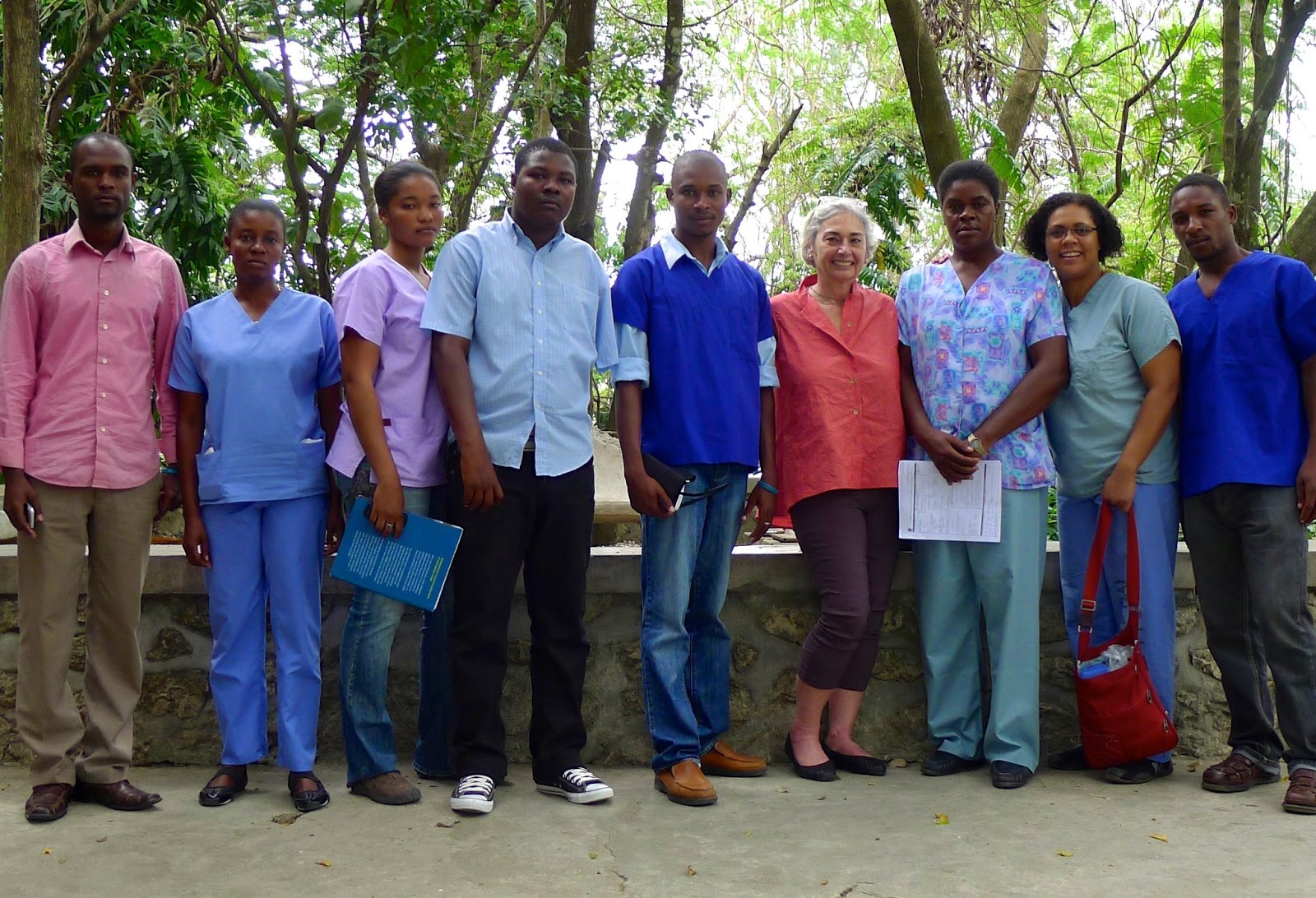
The rehab techs and me 
The entrance to the PT Clinic at
St. Nicholas Hospital in St. Marc--
All sings are in French or Creole
The primary purpose of my visit was to see the work that is being done in rehabilitation at the various clinics.  Given how many pressing needs there are for health care in poor countries, rehabilitation services are not a huge priority because of limited funding.  It is impossible to do everything one would like without an unlimited flow of monies. Although no one disputes the need – just other things are more pressing like improving infant mortality rate, controlling infections (I am sure you've all read about the cholera epidemic, TB, HIV) and improving nutrition but after the devastating earthquake in Haiti, it was clear that rehabilitation and basic physical therapy is necessary to help maximize function.

The entrance at Mirebelais Hospital

I have been a PH supporter for a long time and I got more actively  involved shortly after the earthquake, and with some wonderful Haitian graduate students from Suffolk University, helped to put together a teaching manual for those who care for or have had amputations.  I am also developing a curriculum (along with PTs from Spaulding, MGH and the IHP) for training rehabilitation technicians and accompagnateurs (community health workers).  To make a long story short, I am now part of an advisory board on rehabilitation and the long-term plan is to have a Center for Excellence in Rehabilitation and Education (CERE) as part of the new academic teaching hospital in Mirebalais.   Currently,  there are small programs in Cange (the original clinic started in the Central Plateau), St. Nicolas Hospital in the port of St. Marc and rehabilitation technicians provide home visits to provide follow up care throughout the Central Plateau. Just in case you are wondering, the results are impressive for those that are able to get services and there is a push to expand care in these programs.

Dr Andre Leroy, Director of Rehab with Jordan, 
a medical student at the clinic in Cange

We had a whirlwind 5-day visit that included hospital and clinic visits to L’Hôpital Bon Sauveur  in Cange, L’Hopital Saint Nicolas (HSN) in St. Marc and the magnificent new academic teaching center Hôpital Universitaire de Mirebalais (HUM), in Mirebalais.  I was travelling with my friend Jody Adams who is on the board of PIH and a well-known Chef,  her husband Ken Rivard, and her children Oliver and Roxanne.  I spent time with the rehab team while Jody spent time in the kitchens (and the family also did the hospital visits and visited schools while we were tied up). I was lucky enough to go on rounds with Dr. Andree LeRoy, who is the Director of Rehabilitation for PIH and spent time with the patients and rehabilitation techs.  I was able to meet with these rehab techs and we reviewed cases together, problem solving difficult challenges.  It all felt so natural to me knowing that I could be so helpful (after 40 plus years as a PT, I had the experience of dealing with some of the types of problems that those younger clinicians who work in more modern facilities don’t see anymore).  We all got a chance to meet with the doctors, nurses (including Sheila Davis, who is the director of nursing and her seeing her in action is impressive), volunteers, administrators and many patients.  I was struck by the dedication, enthusiasm and commitment of all those involved plus the pride of the Haitians who work at PIH.  Although the clinics and hospitals are not sophisticated and many procedures we take for granted are not routinely done, the commitment to providing compassionate, humane care is there.  We also spent a long time visiting HUM which is beautiful and clearly will raise the standard of care and health care education in Haiti.  The facility has state of the art operating rooms, imaging equipment, spectacular teaching and patient facilities plus it’s almost 100% solar powered. (it just recently opened and eventually will have 300 beds as the funding increases).  This hospital is truly a major game changer.

The courtyard at Mirebelais Hospital
These lovely mosaics are
 throughout the hospital


Now, I don’t want to give you the impression that life in Haiti is easy.  I am still struggling to make sense of it all…I have never been so up close and personal with people who literally don’t have enough to eat and essentially no resources.  Walking through the markets where the poorest of the poor are trying to make ends meet nearly broke my heart….seeing little kids who are starving  and Moms’ desperate to feed them and people who look like they are 90 when they are only in their 40s is a jolt to one’s soul.  Yet,  most of the Haitians we met were kind, welcoming and always praying for you.  One of the driving forces for my visit, was to better understand the culture and country of Haiti given how much we hear about what a hopeless situation it is….a country that lacks infrastructure with a storied history of massive failures.   Many of my friends have asked me why am I involved in Haiti because the situation is too dire and trying to effect change there is like beating your head against the wall.  Well, the visit confirmed my belief in everyone’s right to health care (and basic necessities ) and although it’s a long uphill battle, I am hooked on the work that PIH does and with all my heart, I know it’s making a difference. Their model of care and developing joint partnerships is translatable worldwide, including this country.  When Paul Farmer (and Ophelia Dahl, Jim Yong Kim and others) started the clinics in the central plateau 25 years ago, the area was deforested….not only did these visionaries work out a wonderful model of using accompagnateurs and partnering with the Haitians, they planted trees…25 years later, the area is beautiful and to me  a testament, that small steps do make a difference… I am in!

     Cange - 25 years later -
    note the beautiful foliage
A little girl that I had the chance to
 work with and her mom


There is no way in this short piece, that I can tell you everything that happened in our whirlwind trip, so I am linking you to my friends Ken and Jody's blog, the Garum Factory who put together a reflective photo journal of our trip on their blog (Ken is both a writer and a photographer) which  includes some of the cultural experiences we had the chance to do.


If you want to learn more about Partners in Health and the work in Haiti, please visit


Click here if you’d like to learn more about the proposed CERE.

And finally, to really understand Haiti and what happened after the January 12, 2010 earthquake you should read the book by Jonathan M. Katz:  The Big Truck That Went By:  How the World Came to Save Haiti and Left Behind a Disaster.

Tuesday, February 19, 2013

Dear Colleagues and Friends,

I hope that you are off somewhere enjoying this long weekend as a respite from your busy and important work. It is Sunday afternoon and it's a snowy blowy day around the harbor. As many who read this will know, I am home recovering from surgery and so I am taking time to express some appreciation. I will write more about all of this in the future.

My personal gratitude for your many expressions of connection/concern/and affection is intense. I enjoy (love!) hearing what is going on at School, with our students and Faculty, and of course, with you. Heather and Peter are keeping me on the grid with regular updates and news.

I am even more grateful for all of the cards, letters, notes, flowers, etc. I promise to get to thank you notes as soon as I can, but know that each point of contact is highly cherished by both Linda and me. Please don't let any delay on my part suggest that I am not noticing all your loving attention!

As anyone who has been through major surgery and healing knows, the process is rarely expedient! I am living that truth for sure, but know that I can't wait to be back at the office with all of you. Perhaps most gratifying is to know that your work, our work, goes on as planned. I see it every day via email, the web page, office notes, minutes, etc. And why wouldn't it? We have such a fantastic leadership team, group of faculty and staff, and students.

Special shout out to Heather, Jorge, and Susan who have produced our unbelievable new calendar. I am so proud and happy for this accomplishment, identified as the number one request from those who use Faculty Compass! Also, the collective work of our admissions committees, OSA, and Marketing in assuring full enrollment over the next term is so great. Thanks to everyone who is making it all jive.

I promise to write soon with some more reflections about what I am learning these days. Again, I hope that you are having a nice holiday weekend! See you soon!

Wednesday, December 19, 2012

26 Random....

For the past several days, I have struggled with the horrible events of last Friday, December 14, 2012.  A shooter entered an elementary school and shot 6 teachers and 20 first graders.   As a parent and grandparent, as a professional, and as someone who hates guns, this one has been hard for me.  The images, indelibly imprinted in my psyche, are terrifying and sad.  
The media has conjectured extensively about the increased possibility of gun control legislation, as well as the flaws and possibilities of the mental health system.  They have also  revealed a new debate as to whether principals and teachers should be armed.   The shooter's mother, also a victim, has been portrayed in sensational ways (survivalist, gun maven, troubled) and a heroine (mother of a son with many challenging behaviors, unable to access needed services).   There is much conflict in each of these discussions.  Now, our society can add epidemic violence to some of our other woes:  the looming fiscal cliff, wars abroad, and  health care reform    Perhaps it is good that it this new "worry" has moved up on the list that politicians, neighbors, and various advocacy groups can argue about.   The combination of the realities of the events of last Friday and the debate that has followed has dampened my holiday spirit, and that of many others around me.  

And then this morning, my wife shared something with me.   Former NBC Today Show host Ann Curry has started a website/twitter feed:  Inspired to Act: #26 Acts of Kindness:  

Curry's message is asking others to join her in committing to 26 random acts of kindness to honor the Newtown children and adults who were killed.  I read down the page, which provides some opportunity to respond and hundreds of people have indicated what they have done, little things and big things, to memorialize the victims and to move forward.   To be honest, reading these "tweets" humbled me.  While I have been focusing on the hopeless sadness of the situation, thousands of others have been doing good things, big and little.   There are notes of Christmas miracles, Jewish mitzvahs, generous donations, letters of apology, and thank you notes to first responders.

It is right to be sad and angry over such "random" violence.  It is not likely that 26 acts of kindness by many will stop the next crazy killing spree.  Our legislators, scientists, the education system, and the health system will have to struggle with this epidemic for a long time.   In the meantime, doing something positive and kind has the potential to communicate what is healthy and hopeful during this most difficult period.  So, I am starting my holiday list late this year.  This year, my holiday to do list focuses on 26 random acts .I want to respond to Ann Curry's little message.  My response won't change the world, it won't change the grief of the sorrowful survivors in Newtown, and it certainly won't change the likelihood that there will be another random killing in the future.  My reason for doing it is selfish.  It will change me, lift my spirits, and might help someone that I work with or someone in my family or someone who needs a little lift.

I hope that this holiday that everyone in the Institute community and your families, have a safe, healthy, happy and wonderful break.  I hope that every one of our students knows that we care about them and their success and that we look forward to seeing them in January.  I hope that every faculty member and staff member at the IHP knows that what we do changes the face and the future of health care-one student at a time.   I also invite everyone to read the "Inspired to Act" site and then join in with 26 big or little random acts.  Do it for yourself.

Best wishes for a wonderful holiday! Peace.

PS-Feel free to list some of your random acts on the blog response below!  Think of the effect!  26 random acts x 1200 students+ (200 faculty and staff) =36,400.  That's big!

Monday, December 3, 2012

Cutting Edge Interprofessional Education


PT, Nursing, and CSD  students share lunch and patient reflection time after a "shift" on the MGH  Interprofessional Dedicated Education Unit


Last Friday I had the opportunity to spend time with several students, clinical faculty members, and preceptors at the Mass General on Ellison 8.  There, each week, an interprofessional group (Nursing, DPT, CSD) students spend time together caring for patients, learning about the work of each of our disciplines, experiencing day long observation of the top notch professional acute care at the MGH, and then spending an hour together reflecting on what the significant learnings were that occurred on that day.

I was able to see a bit of the action that occurred on the floor,but spent more time in the debriefing session at the end of the day.   One of the first observations that I made was that it was difficult to tell what discipline students represented.  They were so sophisticated about the patients that they presented that each one knew the clinical, social, functional, and practical concerns for each patient.   The speech-language pathology students discussed the patient's physical concerns, the physical therapy students were able to talk a lot about communication and swallowing, and the nursing students were remarkably knowledgable about the patient's functional and social situations.   Each student was highly engaged in the discussion and expressed great concern about the needs of the patients from a health perspective, but also from the perspective of future needs, affordabilty of care, and family needs.  

Having had the chance to observe this highly innovative educational pilot was a gift for me.  We are so fortunate to be in a setting where these types of activities are embraced and where our Mass General colleagues are so willing to go the extra mile to make this experience successful and outcomes driven.  We need to continue to find opportunities to develop patient centric teaching and learning situations for all our students!   These opportunities will be transformative in the future of health care!

Sunday, November 11, 2012

Thanks Veterans

It is that time, once again, when we honor Veterans.  These people who have served our country deserve special thanks and appreciation from all of us.

We are especially proud and grateful for those members of the IHP community-faculty, students, alumni, and staff who have served in the armed forces.   Many of these individuals have served as health care providers in the service.

Please join me in saying thanks to this special group of people!

Friday, October 26, 2012

Fantastic Gala 2012


Last night, the Institute’s annual gala  (35th birthday celebration!) was held at the Renaissance Hotel in Boston’s Innovation District, the seaport.  The venue was beautiful.  As always, friends of the IHP filled the room.   Old friends found each other, student scholars were recognized, fantastic staff members made the evening sparkle, there was a lovely dinner.   Even though much of the pattern was the same as in previous years, each gala has a unique story to share or a unique focus.   For last night’s event, several unique features come to mind.

First of all, the key video presentation focused on recent alum Heather Quirk (SON, 2012) and her remarkable story as a young widow, nursing student, parent, and marathon runner.   She represents a uniquely remarkable young woman, who like many of our students and alums have sacrificed and risen above many hurdles to move into their life’s work.    As notable as Heather’s story was her eloquence and graciousness when she thanked those present for their generosity in behalf of all the students who need financial support.  

Second, President Bellack and Board Chair George Thibault praised the start-up of two new academic programs, the MS in Health Professions Education and the PhD in Rehabilitation Sciences, both which have launched in the past few months.   In addition, three of our new faculty researchers were present and were honored.  Drs. Lisa Wood, Tiffany Hogan, and Jordan Green will be part of the Institute’s next chapter of successful contribution to health care transformation.  

And then Trustee Ari Buchler announced the opportunity to participate in an auction to raise money to support students.   Long time friend of the Institute, Sumner Brown had challenged those present to increase their donations by indicating he would add to his already generous gift if over $50000 was raised.   The effect was impressive.   In a few minutes, over $90000 was raised to support students at the Institute.   This amount almost tripled the activity of previous years.  Amazing.

As the Institute celebrates its 35th Birthday, it is fantastic that the wonderful event held last night could honor our work, support our students, look forward to new programs and people, and generate significant financial support for our important mission.   I am grateful to be part of such a remarkable institution.

If you happened to miss the gala and would like to see a video about the Institute's legacy of giving, be sure to check it out:www.mghihp.edu/about-us/ways-to-give/investing-in-the-future.aspx.

Monday, October 1, 2012

Another (Baby) Day at The Institute


Oh Baby! Friday, September 27 was another landmark day for the entry level graduate students at the Institute. The Institute’s annual Baby Day was held for the first time at our newest facility at 2 Constitution Center. Started several years ago by great leaders in the Department of Physical Therapy, Baby Day has become a true interprofessional learning adventure for many, many students. Having the new facility allows more babies and more students and faculty to participate.

Baby Day involves inviting parents to bring in infants and toddlers for observation/assessment and interaction with our students in Nursing, Physical Therapy, and Speech-Language Pathology. For many entry level students (most began their studies less than a month ago), this is a first exposure to typical children and their parents. Watching them crawl, talk, roll over, cry, interact with parents, and explore the environment are fundamental features for assessment of health, development, communication, and motor skills.

Dr. Laura Plummer (SHRS, PT) is responsible for the overall organization of the event, which involves over 150 students, faculty, clinical instructors, and plenty of children and their families. The story as I tell it, reads back to me “another nice thing that the IHP does, “ but doesn’t read as “breakthrough or earth shattering.” It is the back story and the experience that gets my attention and I hope you will think about it.

The Institute works hard to create an interprofessional narrative and to talk about the ways that our students can (must?) learn together and that our faculty must learn to teach together and to teach across disciplinary boundaries. Last month we offered the first ever community service day, allowing students to work side by side to help out the neighborhoods closest to our school. This past Friday, walking around the learning spaces at 2 CC, here is what I observed:
  • Interdisciplinary groups of students huddled together in groups of 15 or so, sitting on the floor, and watching faculty members and Clinical Educators interact with little children;


  • Students focused, almost laser focused, on observing, documenting, and clarifying what they were learning in a completely safe, IPE environment;


  • Faculty members giving up a Friday morning to provide an integrated learning experience for students from all of our programs;


  • These same faculty members teaching students by asking for observations and interpretations;


  • Most impressive, faculty members from one discipline, informing students from other programs about key observations that they make for purposes of referral or enhancing their own practice.


  • Happy parents watching their child interact with a group of remarkable students; and gaining confidence in the next generation of providers of care.
Baby Day was a great day. It was fun and rewarding to see the activities, the teaching, and the learning that was being accomplished in this most impressive space. Our graduate students at the Institute are experiencing a truly remarkable opportunity and this will continue to expand and grow.

Opportunities such as Baby Day, the Community Service Day, and our upcoming Interdisciplinary Lecture occur because faculty leaders choose to go the extra mile to make vital learning work well at the IHP. All I can say is THANK YOU to Anne and to all who made this happen. And also I say, “Oh Baby.”

Thursday, August 30, 2012

Lost and Found: In memory of Lena Sorensen, PhD, RN


       Just two weeks ago, we learned that Dr. Lena Sorensen our colleague, faculty member, teacher, and friend passed away after a very brief illness. We were sad to lose this Institute leader, but relieved to know that her suffering was not lengthy and that she was with her long time partner, Alice Friedman. Expressions of disbelief, grief, and loss have been intermingled with interesting and uplifting stories of Lena’s talents, her passion for her work and her students, and her commitment to connecting patients and providers via technology. Lena had an interesting career, serving several different academic institutions and clinical settings. She was an early adopter of technology advances and pushed to make connections happen that could benefit patients and providers, especially nurses. At the Institute, Lena taught courses in informatics and research, supervised many student projects, and expressed constant delight at her work with her close colleagues in the DNP program, CIPSI, and the School of Nursing. I had the opportunity to work closely with Lena while she served as Chair-Elect and Chair of the Faculty. She worked to bring attention to collaboration around governance, to launch and support a new faculty rank and promotion system, and to include the faculty in important decisions and actions. Lena was also connected with many colleagues in the community. I won’t pretend to know them all but I know that her collaborations with Jeanette Ives-Erickson and Patient Care Services at Mass General and her work with the Center for Connected Health were central to her personal and professional mission. One of her great “moments” of the recent past was when she was invited by Joe Ternullo of the Center for Connected Health to introduce the Prince of Denmark at last year’s Connected Health Symposium! She laughed so much describing all of the ways that the CCH team tried to handle her comments and to reduce the probability that Lena’s natural spontaneity might cause any diplomatic problems! They should have known that Lena’s spontaneity was far from controllable.

     A few years ago, Lena initiated a new way to simulate clinical interactions and education via the virtual world of “Second Life.” Lena and her students struggled through various iterations of the IHP “island”, discovering ways to make their avatar real (or at least have normal clothing), and to explore in a very safe manner some of the complex interactions that occur between patients and providers. Lena was so proud of her “second life” world and the way that her students grumbled at the beginning of the term about having to use this new cumbersome technology and subsequently celebrated their accomplishments at the end of the term. This is the classic continuum of learning-discovery, frustration, deeper exploration, mastery, confidence, competence. Lena celebrated this continuum and I will remember her for these contributions and many more. I think it is somewhat symbolic that her work will live on in something aptly named “Second Life.” I think that you will join me in “finding” Lena there in the virtual world that she helped design.

     The IHP community will gather for a memorial tribute to Lena on September 27 at 5 pm in the beautiful student lounge in 2 Constitution Center. I hope that the whole IHP community-staff, faculty, students-will join us in honoring Lena at that time.

MEMORIAL SERVICE
DR. LENA SORENSEN
SEPTEMBER 27, 2012
5 PM
2 CONSTITUTION CENTER, STUDENT LOUNGE


Monday, June 11, 2012

Third Base: Why do I care so much about Interprofessional Education (IPE)?

Blog Prepared by Dr. Bette Ann Harris

This is the third in a series of submissions this year concerning the Institute opportunity for a "triple play."   Earlier this semester, blogs have been presented about active learning  and inclusive excellence.  The final home run in this series comes from Dr. Bette Ann Harris.  Bette Ann (BA) has the distinctive historical role of being the Institute's very first graduate!   She is now completing 35 years of affiliation with the IHP.   Her history here includes leadership roles  in Physical Therapy, as a Dean, and most recently Associate Provost.   A common theme through her leadership experience has been that of Interprofessional Education.  As the interim Director of CIPSI she has been able to fulfill this long-time passion in interdisciplinary education.   BA will retire from her post in the Provost office in two weeks.    It is wonderful that she has chosen to share with us her rationale for her passion in interprofessional education.  Thanks BA for thirty five great years!
Since the Institute’s inception, interdisciplinary education has been a core value.

Why? We all knew empirically that collaboration and team work worked...many of us who were part of the early days at the Institute had experienced first hand how working together as a team not only improved patient outcomes but created a strong sense of community that together we can make a difference….fast forward to today…it’s still a work in progress but we are gaining on it!

The concept of Interprofessional Education (IPE) has been around for a long time and if you take the time to go back through the literature, you will find a call for educating health professionals together as early as the 1960s citing many common core competencies that apply to all health professionals from beginning skills such as communication, patient safety, culturally competent care to the more complex activities such as leadership, research and clinical decision analysis. Where IPE seems to break down, is how best to teach these skills. (OK, this is blog so I am not going to go into all of the details, but if you are interested in increasing your understanding of the pros and cons of IPE, please refer to the list of references at the end of this article)

In recent years, there has been much more buy-in as to the need for IPE, including incentives for working as a team. For example, many funding agencies, including the National Institutes of Health (NIH) now require that many grant proposals have an interprofessional team of collaborators as well as third party payers of health care. Also, students are demanding more interprofessional opportunities, as they rally together over common health care problems such as health disparities and social justice. In November 2010, there was a wonderful conference at Harvard Medical School that coincided with the seminal Lancet Report: Health Professionals for a New Century: Transforming Education to Strengthen Health Systems in an Interdependent World. Educational leaders from all over the world passionately cited their own experiences with IPE – from collaborations in the field to core curriculums. During one of the questions and answers sessions, a very articulate HMS medical student embraced the need for more interprofessional educational experiences. Like others, he went into health care because he wanted to improve the health and quality of life and make a difference. However, he felt that in an effort to socialize him to his profession, “the passion was beaten out of him” and he should be a physician first, then a humanitarian. From the applause in the room, it was clear that others felt the same way…we need to all focus on the outcome, and recognize each of us from the various professions, do bring a unique set of skills and expertise to the table, but the common goal is the same…to improve the health and well being of those we serve. Much of what we do does cross professional boundaries and if you examine the accreditation standards from the respective disciplines, many of the standards are exactly the same especially around ethics, research, professional behaviors, quality patient care, safety, evidenced based practice, etc, etc. The challenge in education is how to create a curriculum that creates a balance of interprofessional experiences (with core coursework, clinical experiences, activities) with professional specific content so we can graduate students prepared to meet the challenges of health care in the 21st century. No one said it was easy and the Institute is not alone in trying to figure out how to do this effectively and efficiently.

The Institute strives to become a leader in interprofessional education and as a commitment to this vision, the Center for Interprofessional Education and Innovation (CIPSI) was created on January 11, 2011. CIPSI is now the home for several academic programs open to all health professionals including: Health Professions Education, interprofessional content courses (known as HP), the newly established PhD in Health and Rehabilitation Sciences and the Prerequisites for the Health professions courses for those students interested in entering the health professions. CIPSI is also a place where faculty come together to discuss interprofessional curricula opportunities, launch new interprofessional activities, brainstorm innovative ideas and the center serves as a two-way bridge between our schools to move interprofessional opportunities forward. CIPSI is not the only place where interprofessional education takes place and there are exciting new opportunities for students such as the Dedicated Educational Unit (DEU) which was initiated by the School of Nursing and the School of Health and Rehabilitation Sciences. CIPSI, like the rest of the Institute, wants to be known as innovative, creative and to quote Clayton Christensen, disruptive!
As I end my tenure as Associate Provost for Academic Affairs on June 20 and head towards retirement on January 1, 2013, I find myself reflecting on how much the Institute has accomplished over the first 35 years. I am proud to be part of the journey and plan to spend more time working in collaboration with other health professionals (and other disciplines) both on my clinical research and in developing rehabilitation training programs in underserved communities.

Like the Institute, interprofessional collaboration is a core value of mine.


References

Health Professions Education: A Bridge to Quality Ann C. Greiner, Elisa Knebel, Editors, Committee on the Health Professions Summit. ISBN: 0-309-51678-1, 192 pages, 8 1/2 x 11, (2003) This PDF is available from the National Academies Press at: http://www.nap.edu/catalog/10681.html


Core Competencies for Interprofessional Collaborative Practice, Sponsored by the Interprofessional Education Collaborative. Pre-publication recommendations to support activities for the Team Based Competencies Conference, February 16-17, 2011, Washington, DCIPE. PDF is located here: https://www.aamc.org/download/186750/data/core_competencies.pdf

Frenk J, Chen L, Z, et.al: Health professionals for a new century: transforming education to strengthen health systems in an interdependent world. www.thelancet.com Published online November 29, 2010 DOI:10.1016/S0140-6736(10)61854-5. PDF is located here: http://www.mededconference.ca/documents/CommissionReport_000.pdf

Harris, BA: The 2006 Pauline A. Cerasoli Lecture – Interdisciplinary education: what, why and when. Journal of Physical Therapy Education, Vol 20, no. 2, fall 2006, 3-8. PDF is located here: http://cedric.mghihp.edu/v3/dlefile/getfile?id=8538203610282835


What is interprofessionalism? http://highereducationresources.atspace.com/interprofessional.htm