Tuesday, February 22, 2011

Congresswoman Gabrielle Giffords: The Lost Story


Just over a month ago, Congresswoman Gabby Giffords (D-AZ) was shot in the head during a mass shooting in her home city of Tucson.   In this incomprehensible event, numerous others were killed or injured.   The nation’s hearts have been wracked with grief for this terrible tragedy.  As is always true with such events, the news media pounced on the story.     The public (myself included) looked forward to learning of what happened as the story progressed.  We all wanted to know that Giffords had survived.

For several weeks following Gifford’s tragic shooting, the media was filled with images of heroic “scrub clad” surgeons describing the specific details of the brain surgery, and her immediate post-operative recovery.   Descriptions of her early cognitive and motor responses (eye contact, hand squeezing) and removal of her ventilator filled newspapers and TV shows.  Discussions of her inability to communicate (attributed inappropriately to her tracheostomy) were presented repeatedly.  

Once her condition was stable, Congresswoman Giffords was transferred to a rehabilitation hospital in Houston, Texas.   Her husband, Mark Kelly, explained to the media and the world that now that she was moving into rehabilitation, he hoped that their privacy would be respected and that they would not give regular news briefings.  This decision, after such an exhaustive course of events, is completely understandable.  We respect this decision, of course.   Unfortunately, this is just the beginning of a very long story about which the media rarely focuses.

Most of us at the Institute—nurses, physical therapists, speech-language pathologists---all know that the story hardly ended upon discharge from the University of Arizona Hospital.   That was the preface to what is guaranteed to be a long docudrama.     My wish is that the heroes and heroines of the next several chapters of the story had the chance to share their contribution—just like that skilled surgeon.   What would the story sound like?   What would be the plot?

Anyone reading the story would know that the coordination, skill, inter-professional competence, 24 /7 basic and advanced care in a highly integrated set of daily events would be the setting.  The characters involved in this narrative would be graduate level professionals—like those that we educate---who would monitor the congresswoman’s physical and cognitive status on a moment-to-moment basis.  They would develop specific strategies, based on research evidence, to guide her in the direction of recovery.  Those steps in care would involve pharmacologic, behavioral, physiological, and psychological interventions.     Complexities of motor function, cognition, language, speech, swallowing, social and executive functions would be assessed daily, weekly, and monthly using sophisticated measures, technologies, and expert observational skills.   The mental health needs of this important patient and her family would need to be addressed and advanced methods of counseling and support will be used to deal with the emotional complexities of brain recovery and establishing positive skills in coping.    

And the dramatic outcome of the story that started with a bullet will include a whole person, restored as fully as possible to someone who solves problems, socializes with friends, enjoys others, independently carries out needed activities and in that most hoped for outcome, returns to work again. 

I wish that when the media tells their version of the story that they would name the “other” heroes who contribute to this long drama.   The nurses, physical and occupational therapists, the speech-language pathologists and psychologists could all have a dramatic message that would really complete Congresswoman Gabrielle Gifford’s lost story.     

Sunday, January 16, 2011

Martin Luther King Speaks to MGH Institute Community


Wouldn’t this have been a great headline on the Institute website?  At about the same time that MLK was assassinated, the Institute was in its earliest formative years.  Wouldn’t it have been something if Dr. King had been able to have given the first commencement address or speak at the Schwartz rounds?   His message, I am sure, would have been one that focused on urgency for bringing access to all, eliminating disparities and barriers to health care, and assuring that the needs of all people and all providers were addressed.  

Earlier today I heard a talk regarding Dr. King’s message.  The speaker, Dr. Anne Bonnyman, an Episcopal Priest at Trinity Church Boston, referred to a letter that King wrote while imprisoned in Birmingham, Alabama in 1963.   A portion of that letter reads:

“ I cannot sit idly by in Atlanta, and not be concerned about what happens in Birmingham.  Injustice anywhere is a threat to justice everywhere.  We are caught in an inescapable network of mutuality, tied in a single garment of destiny.  Whatever affects one directly, affects all indirectly. “ 
(Source:  King, ML (1964), Why We Can’t Wait. Penguin Group:  New York, NY.)

This quote really could be directed to our faculty and students at the Institute.   To me, it serves as a reminder that we are preparing health providers and leaders for the whole world.   Our students have had the great opportunity to study with and learn from excellent preceptors and mentors in some of Boston’s (and the nation’s) greatest institutions.   This privilege is afforded, I believe, not so that they can all continue their professional roles in this remarkable environment.   In fact, I believe a true measure of our institutional success lies in our graduates’ ability to take what they have learned here, and then to apply these learnings wherever they are most needed.

Are we encouraging our students to use their cutting edge professional education to serve the world?  Are we providing regular, visible, and substantive opportunities for our students to bring their newly formed skills to those places in our city, nation, and the world that are most likely to be transformed by our care?   In each of our programs and disciplines, are we consistently highlighting issues of equal access, disparity, health literacy, and prevention?  Are we assuring that our students leave us with the ability to respectfully and competently apply their skills and knowledge throughout every neighborhood in Boston, and in Haiti, in New Orleans, and other areas where excellent healthcare is not easily found? 

Our new strategic map will provide opportunity and direction for us, regarding those issues that Dr. King raised over 50 years ago. During 2011 (and beyond)  I hope that each and every faculty member and student within the Institute will:
  •  spend time talking about their opportunity to transform health care for everyone,
  • discuss issues of health care in the context of justice, and
  • always remember that “injustice anywhere is a threat to justice everywhere.”   


Tuesday, January 4, 2011

The King's Speech (Pathologist)

Happy 2011!   I hope that each and every member of the IHP community had a wonderful break, a good rest, and joins me in looking forward to a lively semester!   Part of my break time was filled with seeing a few films.   One that was memorable for me was "The King's Speech".  www.kingsspeech.com/

This film is receiving great reviews for the acting performance, the strong writing, and its historical significance.  I liked it for all of those reasons.  However, my reason for discussing "The King's Speech" in this blog is because of some important take home messages offered. 

First of all, let me reveal my bias.  I am a speech-language pathologist and spent many (wonderful) years working with people who stutter, helping young parents cope with their children's stuttering, dealing with prevention of bullying and teasing for PWS I(people who stutter), and  teaching masters and PhD students  in the area of fluency disorders.  It is safe to say that I care deeply about people who stutter and the challenges and compromised quality of life that many of them have experienced.   Given my "bias" and personal interest, it is no surprise that I had great interest in seeing this film.  I expect that many of my SLP colleagues around the world share this enthusiasm.

My great endorsement of this film, though, centers not so much on the interesting and unorthodox representation of speech therapy (by a passionate, devoted, quirky, charming, untrained) speech "therapist".  Rather, the great story of this film is it's portrayal of the stuttering experience by King George, the persistent and postive self motivation for healthy communication, and his accomplishment in coping with his fluency disorder in such a heroic manner.   I believe that the courage and devotion of King George is representative of many, probably most, of the PWS with whom I have been involved.   This part of the story rang true for me.

So, why write about it here?   This movie is so unique in its accurate representation of the stuttering experience.  I have, over the years collected episodes of television shows, cartoons (Porky Pig?), popular movies (http://www.youtube.com/watch?v=wjbkBjYwc84), and some novels that have included persons who stutter as characters.  People who stutter are most often portrayed in these media as cognitively challenged, mentally unhealthy, shy, dangerous, or as the object of ridicule.   How difficult a road this has been for people who stutter.   I always think of that young child, sitting in the movie theater, when the Porky Pig character sputters out "Th-th-th-at's All FFFFFFolks".  How difficult, embarassing, and horrific it must be to have everyone in the room laughing at a caricature of your speech!  Many people who stutter have written about and spoken about this unfair and cruel portrayal as both hurtful and as adding to the burden of their communication problem.

 While this movie portrays the challenge and effort associated with stuttering realistically, it offers hope to people who stutter, portrays the work being done between the clinician and the patient in meaningful and effective ways, and demonstrates the positive result that can be acheived.   Given that 1 in 100 persons stutters, it is likely that all health care providers (not just SLPs) will deal with people who stutter over the course of their career.   My hope is that films such as "The King's Speech" will begin to challenge stereotypic and damaging views of stuttering for all of us!

Thanks for letting me share this "very biased' blog!  "That's All Folks."

Friday, December 17, 2010


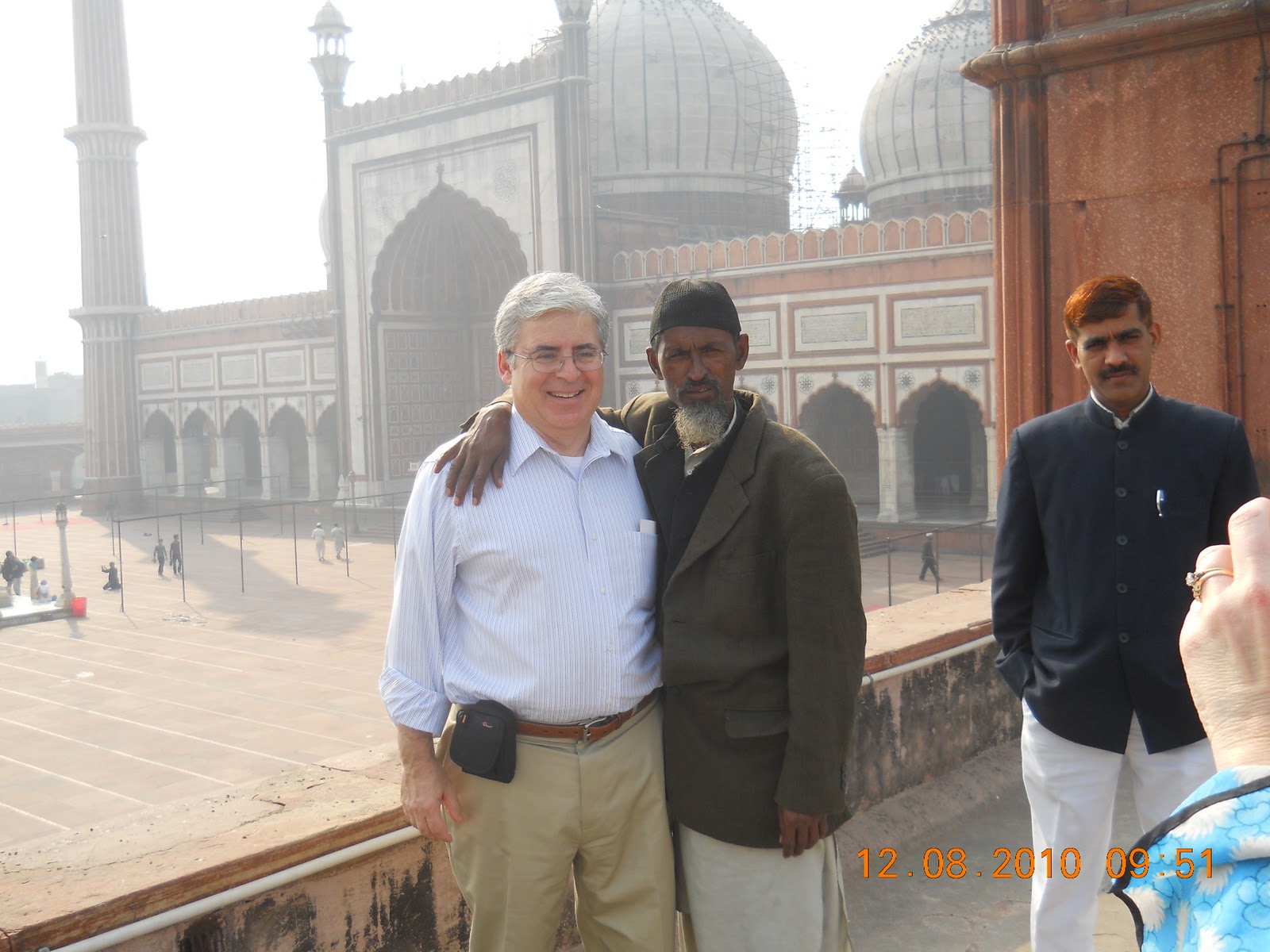
December has provided for some interesting "sights"  for the Institute community.   I had the chance to accompany some Partners' colleagues to Delhi, India in order to explore some collaborative opportunities for the future.  This picture, taken at India's largest mosque, is my favorite one from the trip!

Six faculty members representing our two Schools shared their research results with members of the Board at their recent Board of Trustees Dinner.   During a pre-dinner reception, faculty work was displayed on posters around the room and Trustees had a chance to visit with the faculty members and learn of their contributions.

Faculty members Pat Reidy and Dan Kane  (above)
hosted visitors in the ICU environment.


The lovely patient in the home care setting presented
an interesting mix of  challenges including her own
personal health habits and a bad wig!  By the way, the patient
is Dr. Deb Navedo!
Dr. Marianne Benninato (Physical Therapy) explained her work to Board Chair, Dr. George Thibault during the recent Board Dinner

On another note, Dec. 15 was the Institute Open House for the Simulation Center.  Many faculty members were able to see first hand the simulated home care environment and the ICU environment.  One of the goals of the event was to encourage faculty and student use of simulation in teaching activities.

By the way, the home simulation center is in need of a variety of products, furnishing, and assorted items.  Be sure to check out the list provided by the Simulation group that is posted in the main lobby of the Shouse Building.

Thanks to the faculty members who pulled the "open house" off and made it a big success!
CSD Faculty members Julie Atwood and Lesley Maxwell were seen attending the amazing holiday party hosted by the President!   What an event!   As usual, members of our Institute community raised money for a local shelter and donated two bins of toys for "Toys for Tots."   The marines were present to pick up the goods.  

Wednesday, December 1, 2010

Wake Up; It's December Already

     December Thought #1:  From all of my years in school (when have I ever NOT been in school?), December is always a memorable time.   In elementary school, December meant holiday planning and celebrations; in high school and college  it meant looking forward to a much desired break; and now in my professional life it almost always means time to "take stock."  One of the things that I have been thinking about as I take stock of this year is--how fast we are moving to the future.  I am so optimistic about our future at the Institute, that I almost can't remember all we have been accomplishing.   Rather, I keep wanting to jump ahead to that next exhilerating step.  I know that everyone doesn't always embrace my enthusiasm for change, and I am trying to be respectful of that.  At the same time, I am so excited about what is to come.
       This December, I am making a resolution to look back with appreciation for the wonderful environment in which I work (with each of our faculty members, staff, and students); the accomplishments of our faculty; and the responsibilities that we all take so seriously. As we look ahead together, I am promising myself and all of you to remember the Institute's long history of successful leadership and the recent work that has brought us to this exciting threshold.   More about that in January.....

December Thought # 2:  Today is December 1 and that means it is World AIDS Day.  How far our health care and social systems have come in prevention, treatment, and support of those with AIDS and HIV.  We work in an environment-Partners, MGH, Brigham and of course, the Institute-that has consistently demonstrated strong leadership about AIDS and also in serving those with this disease in a responsible, helpful, and respectful manner.  Today, I am particularly proud of those on our faculty, particularly some of our nursing colleagues, who have exemplified this leadership.   It is suggested that we wear "red" on AIDS awareness day.  Today, I am wearing and AIDS pin that was given to me by some health workers when I visited South Africa in honor of our nursing colleagues at the Institute.  Thanks for your leadership in our program, in Boston, and around the world.

December Thought #3:  Were you able to attend our first ACADEMIC TOWN MEETING?  It was held on November 22 and was well attended by the academic community.  If you missed it, the slides from my comments are available on the intranet.   As always, I am happy to answer any questions or hear comments from the Intstitute community.

Monday, November 1, 2010

On Giving Thanks: Some IHP Thoughts


      Almost every culture has a celebration of remembrance and gratitude. In the United States and Canada, Thanksgiving is the holiday where we spend time acknowledging those people and events that we appreciate most. In a few weeks, most of us will be spending time with friends or family (or maybe sharing time with a student or colleague who is new to Boston) and sharing in this great American holiday tradition.
           This year, as I celebrate Thanksgiving with my own family, I will also be remembering some aspects of the Institute community for which I am most grateful.   First of all, I am so appreciative to be part of this remarkable group of colleagues and students. We are all working together to prepare the future leaders of health care delivery, and this is an honor beyond words.
I am grateful for those in the larger community who have their eyes (and hearts) on the Institute. Having just come from the annual Scholarship Gala, I am filled with appreciation for those who are so generous in support of our work, the volunteers who contribute so much to our strength and impact.
  I am thankful to be part of the larger health system and education arena in Boston. Our city’s health institutions, especially our Partners’ colleagues, are transforming health care every day. Our friends in the health and education community add value to our educational programs, precept and mentor our students, and honor us by their commitment.
I am thankful for the enthusiastic and energetic staff who “keep the trains running on time” at the Institute. Our support structures are small, so as not to add to the cost of educating our students. Despite our size, our staff operates to get the job done, assures high quality services and responsiveness, and provides considerable value to the educational enterprise.
I could go on and on with this catalog of appreciation. Instead, I hope that my own reflection encourages you to think about the Institute community with gratitude.  Happy Thanksgiving to the whole community!


Friday, October 15, 2010

Happy Birthday Physical Therapy

This weekend, the Department of Physical Therapy is celebrating the 30th Anniversary of PT at the Institute. Alumni, faculty, and friends will come together for social and educational events. PT Chair (and Interim Dean of SHRS) Leslie Portney has produced a publication that reports the history of the program. Congratulations to our PT faculty, students, and alumni!

This birthday celebration of PT, which coincides with National PT Month, is a reminder of the important contribution that our PT programs make to the life of the Institute. From an educational standpoint, our program is recognized for cutting edge curricula, and is ranked 7th in the nation and first in the northeast by US News and World Report. Faculty in PT contribute as Institute leaders, and many have high profiles in the American Physical Therapy Association. Our remarkable and talented Physical Therapy students participate in wellness projects that impact many aspects of the community and they conduct an annual dodgeball tournament that raises thousands of dollars for charity.

The impact of the PT Department extends beyond the classroom. This past year, the program opened an exciting new clinic for the community. Located on the third floor of the Shouse Building, the clinic provides physical therapy services to individuals also being seen in the Speech and Language Center, and to our Charlestown and Navy Yard neighbors. The clinic is staffed by our students two days per week and he schedule is already full.

Finally, the PT program is unique in its international master's program. This program is customized to meet the needs of internationally licensed physical therapists who wish to accomplish advanced study in the U.S. These phenomenal individuals from around the world add much to the life of the Institute.

I hope that everyone in the Institute community will take a moment to say "thanks and congratulations" to our colleagues in Physical Therapy! We are all so grateful for your leadership and service!  Happy Birthday PT!

Sunday, October 10, 2010

A Complicated Journey

I returned late last evening from a week long trip to Israel. This was the fourth "People to People" trip that I have led in the past three years. I was able to lead 30 Speech-Language Pathologists to Israel for professional exchange with each other via Continuing Education, with colleagues in universities, hospitals, and clinics in Tel Aviv, Haifa, and Jerusalem, and also to tour important historical and religious sites. What a trip! Exhausting and exhilarating and filled with surprises and learning! The trip was not affiliated with the Institute and was not sponsored by the Institute (just in case you were wondering!). What a great way to use some of my annual vacation leave. Some thoughts that I will spend time (alone, not on here) thinking about over the coming months--

+speech-language pathologists from the US and Israel have much in common and services are similar in many ways, though not identical. Passion for people with communication disabilities, health issues, and quality of life are universal concerns. We have wonderful Israeli colleagues.

+In the higher education and clinical sites that we visited there was multicultural concern about assuring that access to services was available for people of diverse religions and languages. Regardless of the political issues that are so prevalent in that small country, there is consistent passionate concern for the rights to access services, to develop a diverse pool of SLPs, and address cultural competence. One university, Hadassah (Jerusalem) will open a new MS degree program with an emphasis on multicultural competence.

+The political, historical, and religious conflict in Israel are complex and defy resolution. Israeli and Palestinians are able to express concerns for each other, while experiencing great anxiety about compromise. Not surprising, there are diverse opinions within groups as well as between them. I am anxious to read more, learn more, and develop a better understanding of the political environment.

+Israel is prepared for violence and war. All young people enter the army for 2-3 years after high school. At first it is a bit alarming to see 20 year olds walking around, some out of uniform, carrying large weapons. Airport security is much more complex than the US (I didn't know that was possible). The largest hospital in Israel (Sheba) is equipped with a complete underground alternative hospital, that is available should there be war on the ground. It is maintained 24/7, even though it has never been used. We also saw outdoor gurneys and showers to be used if there are chemical attacks. One of our meetings at a preschool program for deaf children was held in a basement room, that is a bomb shelter. Every public building has bomb shelters. Reality is in your face everywhere in Israel; but people are happy, positive, and confident. Amazing!

+Socialized health care is working well and colleagues with whom we spoke were encouraging about our future. Some examples---all children under 6 are screened for all problems possible and covered for health, habilitative, and rehabilitative services. We saw a treatment program for 6 month old high risk infants that was beyond belief. Talk about investing in the future. They have much to teach us. Similarly, cochlear implants are universally covered for children with hearing loss, if the parents desire the implant (this is hardly true in the US). Rehabilitation hospitals have patients in treatment for PT, SLP, and OT for several months after onset of the disability. Their system is quite impressive and there is high regard across the system for interdisciplinary collaboration.

I come back to the Institute with a renewed sense of commitment to assuring that our future in the new health care system assures access for patients with ALL types of needs, that we assure that all of our students understand the importance of primary and generalist care as critical to such access, and with an appreciation for the work of our colleagues in Israel.

Stop by and I can share some pictures with you! It was a wonderful trip. Mazel Tov.

Wednesday, September 29, 2010

Violence, Concern, and The Institute

Over the past week we have learned of shootings and stabbings at Regis College, Boston College, and at Seton Hall University. These important institutions with strong religious and service identities are the last place one might expect to observe such violence. This morning, in the Boston Globe we see reports and commentary about the recent violence in our city that has led to the death of a young mother and her preschool child. This is so much food for thought and for thinking about safety, social issues and trauma, coping and the list goes on.

Earlier today, I had an email exchange with my good friend and colleague, Dean Brian Shulman at Seton Hall. His response to my attempted words of concern and encouragement: "We will get through this." These heroic words have been used so many times in recent years, as our educational institutions and the young people who are their focus have come under attack. Academic leaders and others seem to constantly have to remind their stakeholders that recovery is possible, that confidence in the future should not be underminded by a single event, and that the collective "we" is fundamental to recovery.

The images associated with these acts of violence trigger many concerns for me (and I am sure for all of us), I am trying to put my own thoughts around what we can do in the Institute community. First, assuring that we provide a safe environment for our work and study. All of us should take note of any person or situation that seems questionable. The MGH Police Officers and Security system are excellent and are available to us 24/7. Second, we should be sure that our students, as health providers, are prepared to deal with the acute and chronic "symptoms" experienced by those touched by violence. These are our patients, families, clients, and potentially our students and colleagues. Learning to communicate with, develop trust with, and address the needs of those who have experienced these problems should be part of our core skills as practitioners. We should be asking about our competence in dealing with trauma, grief, coping, and long term support and rehabilitation for those affected by violence. Finally, we should all recognize our own collective and individual role in preventing violence in the first place. The literature and the popular media have promoted the concept of the "first responder" as those individuals who intervene after an emergent situation has occurred. I believe that in many cases, those individuals are the "second responders." My hope is that our faculty, students, and alumni are true first responders--individuals who devote their work and energy to being the one who prevents, to the degree possible, the kind of violence that we have recently experienced.

Monday, September 20, 2010

Hindsight and Foresight

Last week I distributed two documents. The first, a summary of the "academic" progress of the Institute tells the story of all that you and your students and colleagues have done to make the Institute better in teaching, service, and research over the past year. The second, The Role of the IHP in Health Care Education of the Future, provided a series of questions and reflections for the faculty to consider as we engage in strategic planning over this fall term.

As I thought about "Vision 2020", our strategic planning process, I found it very helpful to use the accomplishments and challenges of the past year to serve as the foundation for thoughts about the future. We have accomplished so much! Rather than listening to those random voices of frustration about the volume of work that remains to be done, looking backward helps me see that we can be confident that it is all do-able.

So, as we enter this time of planning and focus on the longer term, I hope that you find the opportunity to join me in an optimistic view in Vision 2020. In fact my wish for all of us is that we can share 20/20 vision about Vision 2020!
Have a great week.